Ju EF100 windtunnel model
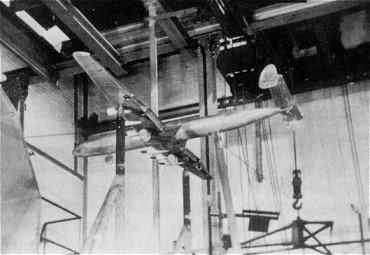
Above image from Geheimprojekte der Luftwaffe Band II: Strategische Bomber 1935-1945
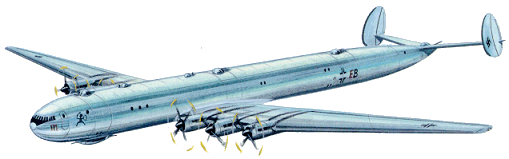
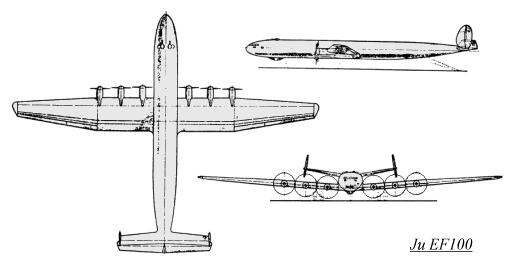 Although the Junkers Ju EF100 was originally begun as a trans-Atlantic
airliner under the designation of EF53, for post WWII use, its design was
changed to be a long range, maritime reconnaissance and bomber. The aircraft
was to be of all-metal construction, with the fuselage having a "double-circle"
cross-section. A loading ramp was located in the rear lower fuselage, such
as the later Ju 252 and Ju 352 used. The wings were located low on the
fuselage, and had six Jumo 223 Diesel 24-cylinder engines mounted on the
wing leading edge. The tail unit was of a double fin and rudder layout,
with the tailplane featuring considerable dihedral. A tricycle landing
gear arrangement was chosen, with the main gear having double wheels.
Although the Junkers Ju EF100 was originally begun as a trans-Atlantic
airliner under the designation of EF53, for post WWII use, its design was
changed to be a long range, maritime reconnaissance and bomber. The aircraft
was to be of all-metal construction, with the fuselage having a "double-circle"
cross-section. A loading ramp was located in the rear lower fuselage, such
as the later Ju 252 and Ju 352 used. The wings were located low on the
fuselage, and had six Jumo 223 Diesel 24-cylinder engines mounted on the
wing leading edge. The tail unit was of a double fin and rudder layout,
with the tailplane featuring considerable dihedral. A tricycle landing
gear arrangement was chosen, with the main gear having double wheels.
| Span | Length | Height | Wing Area |
| 65 m
213' 4" |
49.8 m
163' 5" |
9 m
29' 6" |
350 m²
3767 ft² |
| Empty Weight Equipped | Flying Weight | Additional Load | Bomb Load | Wing Load |
| 44200 kg
97444 lbs |
74500 kg
164244 lbs |
30300 kg
66800 lbs |
5000 kg
11023 lbs |
212.8 kg/m²
43.6 lbs/ft² |
| Max. Speed | Cruising
Speed |
Takeoff
Distance |
Landing
Distance |
Landing
Speed |
Ceiling | Range |
| 570 km/h
354 mph |
545 km/h
339 mph |
550 m
1804' |
510 m
1673' |
122 km/h
76 mph |
12300 m
40354' |
100 pass. 4000 km (2485 miles)
75 pass. 6000 km (3728 miles) 50 pass. 9000 km (5592 miles) Military Load 9000 km (5592 miles) |
| Junkers Ju EF100 Models |
| There are no models of the Junkers Ju EF100 available at the present time |
Ju EF100 windtunnel model
Above image from Geheimprojekte der Luftwaffe Band II: Strategische Bomber 1935-1945