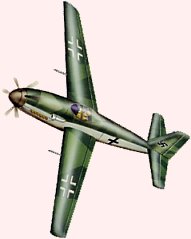
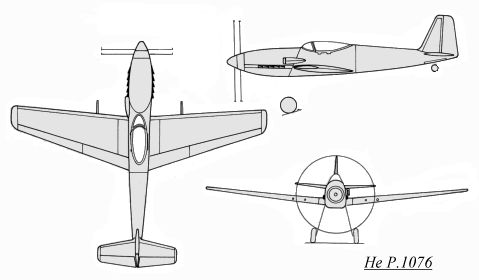
 In late 1944, the Heinkel firm designed this project to meet a RLM specification
for a fast piston-engined fighter with an good high altitude performance.
Designer Siegfried Günter used the He 100 design (which briefly held
the world speed record at 746.606 km/h (463 mph) on March 30, 1939) as
his inspiration. The He P.1076 was thus designed to have a very smooth
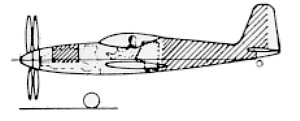
surface, and used a surface evaporation cooling system on the engine cowling
and the entire fuselage rear section (see drawing below). The wing
was slightly swept forward at 8 degrees and was constucted as a two-piece,
two spar all metal structure. There were flaps on the entire wing trailing
edge, with the outermost as ailerons and the inside ones as landing flaps.
Three different engines were envisioned: the Daimler Benz DB 603M, Jumo
213E and Daimler Benz DB 603N (see table below). The landing gear retracted
normally, the main gearinto the wing center section and the tail wheel
into the rear fuselage. A single 700 liter (185 gallon) fuel tank was located
in the fuselage behind the pilot's seat. The cockpit was pressurized and
was supplied with a clear-vision canopy. Armament was to consist of one
MK 103 30mm cannon firing through the propeller hub, and two wing-mounted
MK 108 30mm cannon. Although this project did not see the light of day
(although Siegfried Günter completed detailed drawings and plans for
the Americans in mid-1945), it probably would have been one of the fastest
piston-engined propeller aircraft ever built.
In late 1944, the Heinkel firm designed this project to meet a RLM specification
for a fast piston-engined fighter with an good high altitude performance.
Designer Siegfried Günter used the He 100 design (which briefly held
the world speed record at 746.606 km/h (463 mph) on March 30, 1939) as
his inspiration. The He P.1076 was thus designed to have a very smooth
surface, and used a surface evaporation cooling system on the engine cowling
and the entire fuselage rear section (see drawing below). The wing
was slightly swept forward at 8 degrees and was constucted as a two-piece,
two spar all metal structure. There were flaps on the entire wing trailing
edge, with the outermost as ailerons and the inside ones as landing flaps.
Three different engines were envisioned: the Daimler Benz DB 603M, Jumo
213E and Daimler Benz DB 603N (see table below). The landing gear retracted
normally, the main gearinto the wing center section and the tail wheel
into the rear fuselage. A single 700 liter (185 gallon) fuel tank was located
in the fuselage behind the pilot's seat. The cockpit was pressurized and
was supplied with a clear-vision canopy. Armament was to consist of one
MK 103 30mm cannon firing through the propeller hub, and two wing-mounted
MK 108 30mm cannon. Although this project did not see the light of day
(although Siegfried Günter completed detailed drawings and plans for
the Americans in mid-1945), it probably would have been one of the fastest
piston-engined propeller aircraft ever built.
A diagram of the of the He P.1076
evaporation cooling system locations
| Engine | Take-Off Power | Power w/MW50
Injection Boost |
| Daimler Benz DB 603M
twin supercharged |
1825 HP | 2100 HP |
| Junkers Jumo 213E
two-stage, three speed supercharger |
1750 HP | 2100 HP |
| Daimler Benz DB 603N
two-stage twin supercharger w/integrated heat exchange cooler and contra-rotating three blade VDM propellers |
2750 HP | N/A |