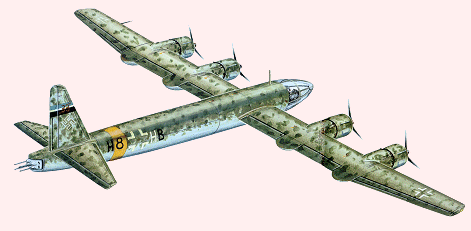
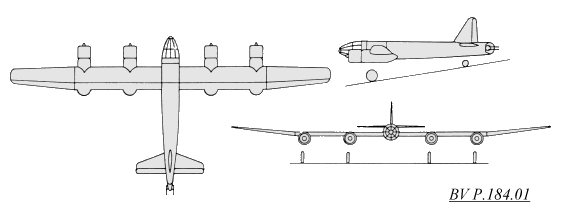
 The Blohm & Voss P.184.01 was designed to be a long range bomber and
reconnaissance aircraft, and was one of Dr. Richard Vogt's (chief designer
and project office manager of Blohm & Voss) more interesting designs.
The aircraft was to have been constructed almost entirely of steel. The
wings were long and untapered, and were mounted low on the fuselage. An
ingenious feature of the wings were their construction method. A box shaped
spar ran the length of the wings, and were designed to also hold the majority
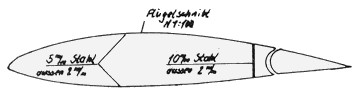
of the P.184.01's fuel supply. In the first third of the wing's chord,
an angled steel partition wall of 5 mm thickness was placed and the rear
partition wall was 10 mm thick (see diagram below). The wing surface was
to be covered in 2 mm plate steel. There was also a single fuselage tank
with a diameter of 1.8 meters. The four BMW 801E double radial engines
of 1600 hp were attached to the wing's steel box spar and a single landing
gear leg retracted to the rear of each engine nacelle. The tail assembly
consisted of a traditional fin/rudder and tail planes, with a retractable
tail wheel located beneath the rear fuselage. A pressurized cockpit located
in the fuselage's fully glazed nose held a crew of five, where the remote-controlled
tail armament (two MG 131 machine guns) could be aimed by the use of a
periscope system. There was also a single MK 103 30 mm cannon in the nose.
The bomber version could carry 4000 kg (8800 lbs) of bombs in lieu of the
camera equipment.
The Blohm & Voss P.184.01 was designed to be a long range bomber and
reconnaissance aircraft, and was one of Dr. Richard Vogt's (chief designer
and project office manager of Blohm & Voss) more interesting designs.
The aircraft was to have been constructed almost entirely of steel. The
wings were long and untapered, and were mounted low on the fuselage. An
ingenious feature of the wings were their construction method. A box shaped
spar ran the length of the wings, and were designed to also hold the majority
of the P.184.01's fuel supply. In the first third of the wing's chord,
an angled steel partition wall of 5 mm thickness was placed and the rear
partition wall was 10 mm thick (see diagram below). The wing surface was
to be covered in 2 mm plate steel. There was also a single fuselage tank
with a diameter of 1.8 meters. The four BMW 801E double radial engines
of 1600 hp were attached to the wing's steel box spar and a single landing
gear leg retracted to the rear of each engine nacelle. The tail assembly
consisted of a traditional fin/rudder and tail planes, with a retractable
tail wheel located beneath the rear fuselage. A pressurized cockpit located
in the fuselage's fully glazed nose held a crew of five, where the remote-controlled
tail armament (two MG 131 machine guns) could be aimed by the use of a
periscope system. There was also a single MK 103 30 mm cannon in the nose.
The bomber version could carry 4000 kg (8800 lbs) of bombs in lieu of the
camera equipment.
| Span
|
Length
|
Height
|
Wing Area | Flying Weight
(without bombs) |
Range
|
Service Ceiling | Rate of
Climb |
Take Off
Distance |
Landing Speed | Max.
Speed |
||||||||
| 35.8 m 117' 5" | 17.3 m
56' 9" |
6.6 m
21' 7.8" |
82 m²
882.6 ft² |
39225 kg
86475 lbs |
7500 km
4688 miles |
8840 m
29000' |
|
|
171 km/h
106 mph |
500 km/h
311 mph |